


Deciding Your Plow Configuration
How many horse power per shank (tyne or leg). Whether a three point linkage plow or a trailing model. Size of tines to suit. This guide is designed for anyone interested in purchasing a Yeomans Plow, whether it’s your first or a subsequent addition to your farm. It will help you understand the options and suggest the best configuration for your specific needs.
How to decide a plow size?
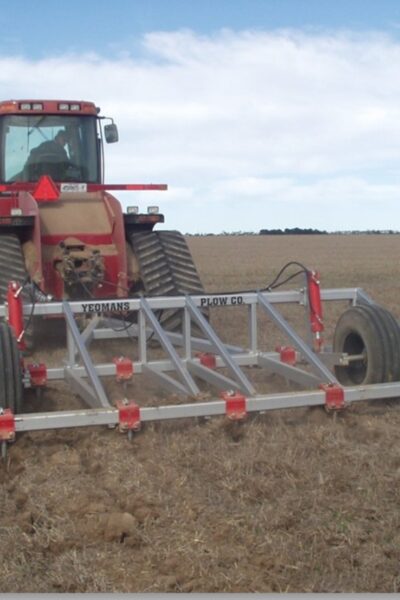
Selecting the correct plow frame starts with matching the implement to both your tractor and your property. Horsepower is the primary limiter—each shank requires around 7 to 15 horsepower. Initial requirements can be as high as 20 to 30HP. The number of shanks should always be sized conservatively, around 10hp per shank to maintain working depth and speed rather than maximising width. To start, only fit enough shanks that are comfortable to pull. Spread them out over the width of the plow. You can also get more shanks next season when the soil has developed and the plow is easier to pull.
NOTE: While rated at a certain horsepower, some utility tractors may lack sufficient weight to effectively transfer that power to the ground. In these cases, traction rather than engine output becomes the limiting factor. Use the high end of the recommended HP range for these tractors.
Frame width and shank spacing should then be chosen to suit your layout, including the width of gates, row spacings, and headlands, as well as the available space to safely manoeuvre the tractor and plow, especially in orchards, vineyards, or smaller paddocks. Wider, multi‑beam frames provide greater coverage and flexibility for broadacre or pasture work, while narrower frames improve access and control in tight or undulating country. Soil conditions, terrain, and the intended job—such as pasture renovation, deep ripping, or inter‑row cultivation—should also influence frame selection to ensure the plow works efficiently while protecting soil structure and tractor longevity.
Three-point linkage, trailing models, which to choose?
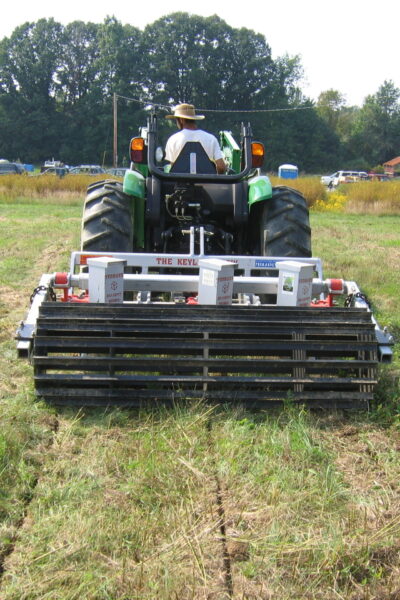
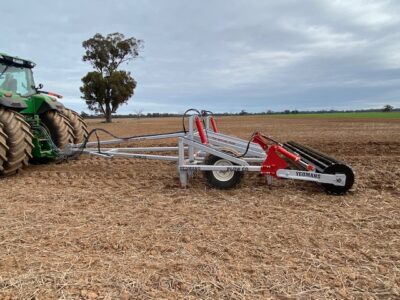
The choice between a three‑point linkage (3PL) and a trailing plow is influenced by several practical factors, including tractor horsepower, crop type, paddock size, terrain, and farm infrastructure such as gate widths. For tractors below approximately 150 horsepower, three‑point linkage models are generally preferred, particularly for row crops, irrigation bays, and smaller paddocks where manoeuvrability and precise control are important. Steep or undulating country also favours 3PL plows, as they are easier to handle on turns and headlands. Trailing models are more commonly matched with higher‑horsepower or crawler tractors and are well suited to larger paddocks, offering a slightly improved pulling angle that can aid penetration at greater working depths. While trailing plows represent a higher upfront investment, they can be easier to integrate with air seeders—either by towing a seeder behind the plow or operating the plow behind a seeding unit—making them a practical option for broadacre and combined operations.
Depth Control?
Yeomans plows are designed so the shanks naturally pull themselves into the ground, which is part of what makes them so effective at fracturing compacted soil. However, some form of depth control is strongly recommended to limit this self‑penetrating action and ensure the plow operates at the intended working depth, rather than going unnecessarily deep and wasting tractor power. In some circumstances the crumble roller or tractors can be used for limited depth control but it is not a recommended solution for maintaining constant depth.
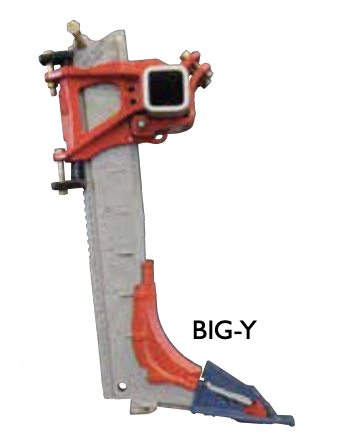
Shank Length
Shank length should be chosen based on the depth of compaction you are addressing, the type of work being undertaken, and the available tractor horsepower. Yeomans shanks are designed for subsoil fracturing rather than surface cultivation, so the objective is to work just deep enough to open compacted layers while maintaining efficient draft and consistent soil lift.
What are the typical shank spacings ?
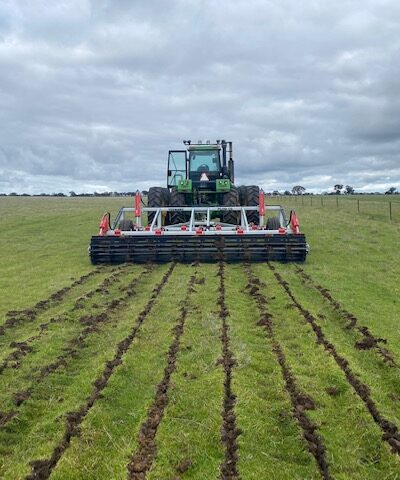
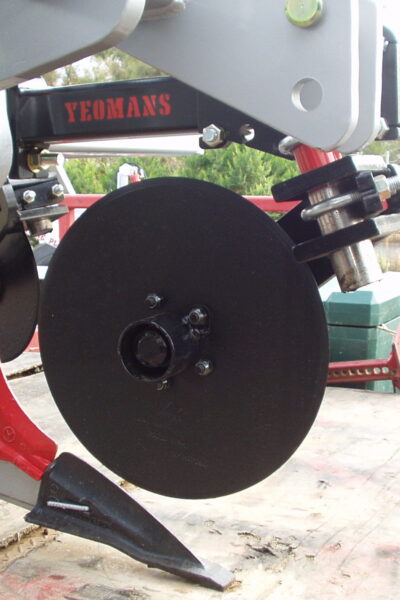
Coulters
Coulters are used to cut and part surface material ahead of the shank, allowing the Yeomans plow to pass through cleanly while minimising tearing, dragging or surface disturbance. Coulters do not affect the subsoiling action below the surface.
Coulters are often useful in:
- shallow, densely matted pasture
- vine‑type groundcovers that tend to bunch
View Photo comparison of coulters vs no coulters
Crumble Roller
A crumble roller is used when you want to finish the job in one pass—leaving the soil level, stable and protected immediately after Keyline plowing, rather than loose or ridged.
Yeomans plows are designed to fracture the subsoil without turning it over, but depending on soil type, moisture and surface cover, the plowing action can leave raised lines or loosened surface material. A crumble roller gently reconsolidates the surface, pressing fractured soil back into contact without destroying the subsoil fissures created by the plow.
You are most likely to need a crumble roller when:
- You are working light, sandy or friable soils
In lighter soils, subsoiling can lift and fluff the surface excessively. A crumble roller firms the soil just enough to prevent wind erosion and moisture loss while keeping the soil profile open below. - You are renovating pasture and want a clean finish
After pasture renovation, a crumble roller leaves a smooth, stock‑safe surface that can be grazed or oversown sooner, without ridges or loose clods that interfere with seed‑to‑soil contact. - You want to retain surface moisture
Loose soil dries quickly. By lightly consolidating the surface, a crumble roller helps seal moisture in, complementing the Yeomans plow’s role in improving infiltration and subsoil water storage. - You are preparing ground for follow‑up operations
Where spraying, mowing, sowing or harvesting equipment will follow, the crumble roller produces a level, traffic‑ready finish, reducing the need for additional passes. - You are aiming for maximum biological benefit
Keyline plowing is about stimulating soil biology through aeration and moisture movement. The crumble roller supports this by maintaining soil structure, avoiding excessive disturbance at the surface while allowing air, water and roots to move freely below.
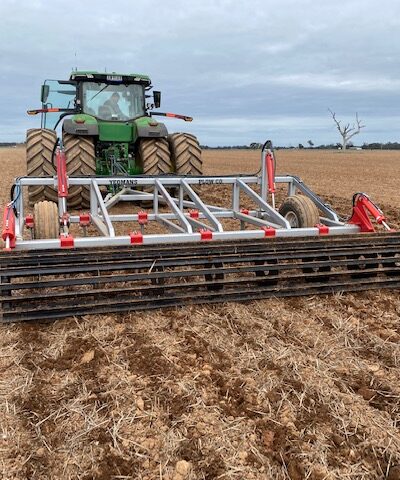
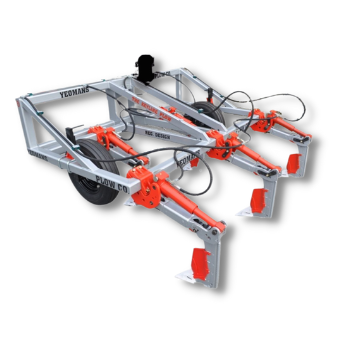
Hydraulic Stump Jump System
The Yeomans Stump Jump system is designed to protect both the plow and tractor when working in rocky, root‑bound, or previously uncultivated ground. It allows each shank to safely lift and pass over immovable obstacles—such as rocks, stumps, or buried timber—without damaging the frame or bringing the tractor to an abrupt stop. This makes it possible to subsoil country that would otherwise be considered difficult or “uncultivatable”.
- Virgin or long‑uncultivated country where rocks, stumps, and roots are likely to be encountered
- Cleared grazing land with buried timber or old tree roots
- Rocky soils or shallow bedrock areas where solid obstructions cannot be avoided
Weeding
Yeomans offer a number of different solutions for controlling weeds:
Weed Knives
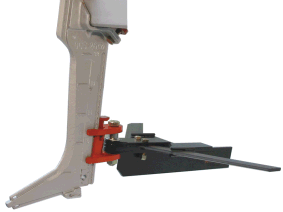
The weed knife is a light, shallow‑working tool designed for effective weed control with minimal soil disturbance, particularly in already worked or relatively stone‑free ground. Mounted to the Yeomans shank system, the knife slices cleanly through small weeds just below the soil surface, severing roots while leaving the soil profile largely intact.
- the blade assembly pivots sideways on a heavy duty pin
- when an obstacle is hit, one blade swings back while the other advances
- a central vertical fin keeps the system tracking straight
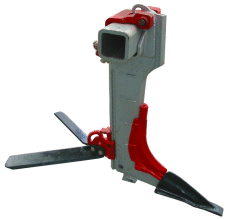
Batswings are heavy‑duty sweeps used for:
- weed control
- shallow cultivation where sweeps are appropriate
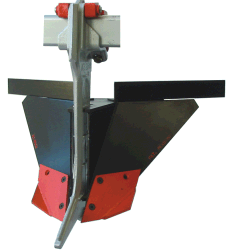
Furrows & Hillers
Yeomans plows can be configured to form furrows, hill soil, and manage irrigation or row‑crop systems using a range of purpose‑built attachments rather than single‑use implements.
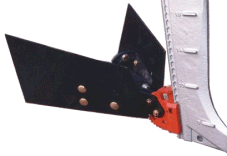
For flexible row formation, the Yeomans Adjustable Hiller allows operators to vary the amount and direction of soil throw, making it well suited to crops requiring adjustable bed widths or seasonal re‑shaping. For consistent, repeatable row profiles, the Fixed Stealth Hiller provides a robust, low‑maintenance solution where uniform furrow and hill shape is required, such as in irrigation layouts or permanent row systems.
Yeomans also offer Batswings, which can be inverted to throw soil inward for hilling or outward for furrow formation, and Wobble Blades, which are ideal for furrow maintenance and light hilling in rocky or root‑bound ground where rigid tools would be damaged. Together, these options allow growers to create and maintain hills and furrows while simultaneously improving subsoil structure, enabling one Yeomans frame to perform subsoiling, hilling, furrowing, and inter‑row cultivation simply by changing attachments to the back of the shank to suit the job and conditions.
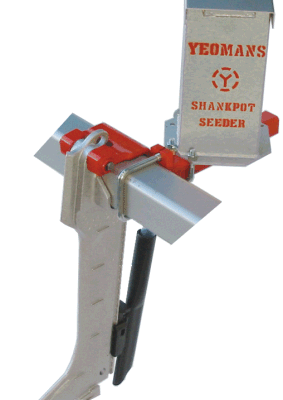
Tickle Pot Seeder
The Yeomans Tickle‑Pot Seeder is a simple and reliable system for applying seed or fertiliser while Keyline plowing. It uses the proven tickler (jiggler) principle to deliver a consistent, adjustable flow, even on slopes or when the pot is nearly empty. Seed is placed on or just below the soil surface, directly above the fractured subsoil, where moisture and biological activity have been improved by the plow. This makes the system particularly effective for pasture regeneration, oversowing, legumes, cover crops, and soil‑building species, allowing soil improvement and seeding to be carried out in a single, low‑disturbance pass.